Tuesday, August 17, 2010

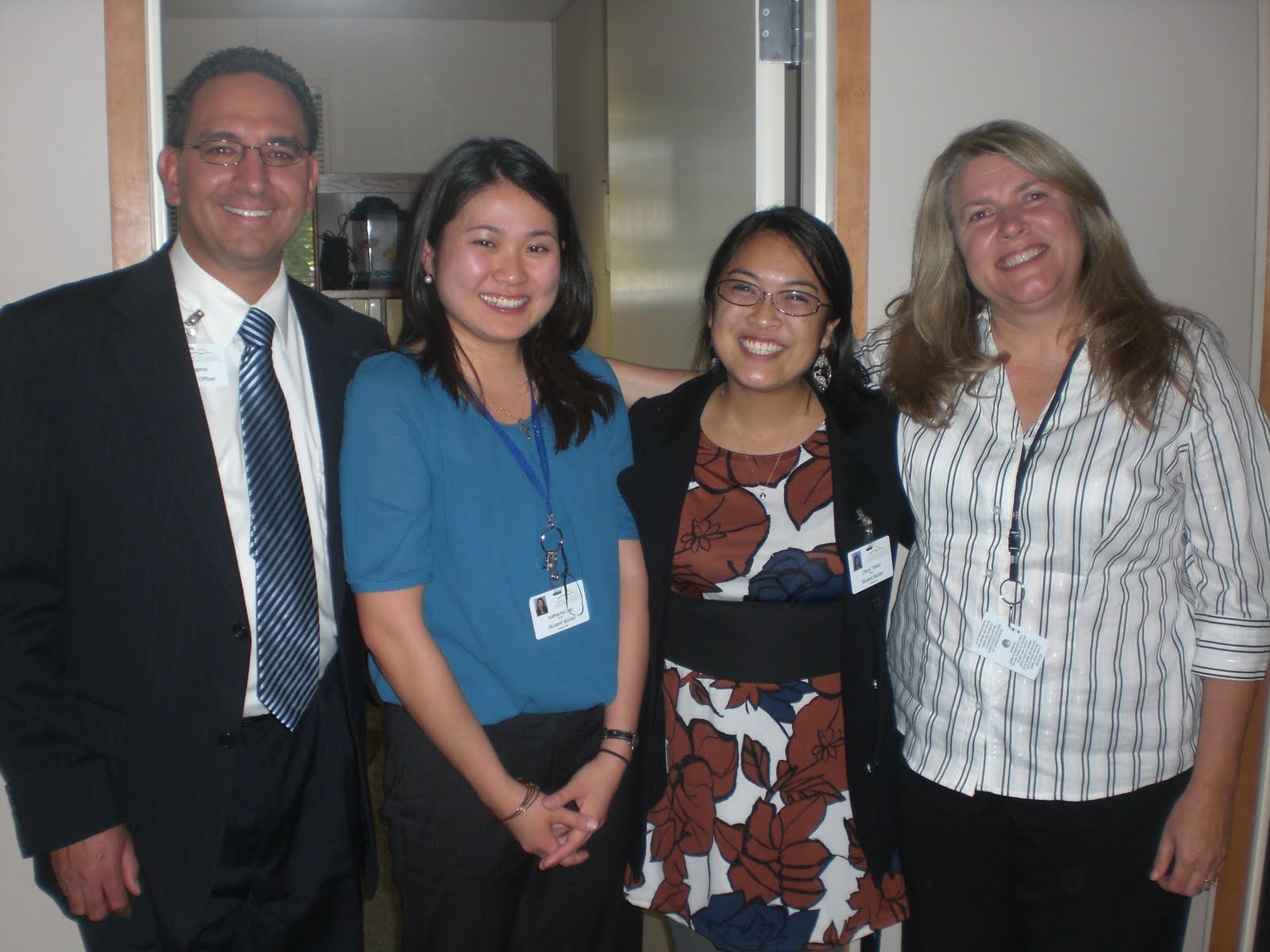
UCB Interns Rock!

Posted by Julie Kelley, Mental Health Program Chief
Don't forget to come to the Improvement Academy on Thursday at 9:00. The UCB Public Health Interns are presenting their Gap Analysis of the IHI Improvement Map. Having had a preview, I can assure you're in for a treat

Also, we look forward to hearing about your plans to include patients/family members on your Improvement Teams.

See you there.

Julie Kelley
Mental Health Program Chief

Monday, August 9, 2010

Embracing the Uncomfortable

Posted by Katherine Lao, CCRMC Graduate Student Intern / MPH Candidate / UC Berkeley School of Public Health

Prior to working for CCRMC, I spent some working in programs referred to as “health-pipeline” programs that worked towards addressing health disparities by developing healthcare professionals from underserved and underrepresented backgrounds. I was a 20-year old intern at that time, and I immensely grateful for these programs to opening the world of healthcare, diversity, and social justice to me. In many ways, the students that I have met and their passions, motivations and inspirations for going into the field of healthcare have also become mine.


While I personally did not live in disparity, I spent a good amount of life growing up around it. I was born and raised in a middle class/upper middle class family in Manila, Philippines, and I remember daily pictures of families living underneath bridges, street children selling cigarettes or knocking on car windows to make a living, and next door neighbors without the resources to take care of their sick children. Poverty surrounded me every single day and while I constantly wondered why it was that way, I had also learned to accept it as the norm and had somehow became numb to the suffering around me.


I went back to the Philippines for the first time three years later (back in 2003), and I clearly remember the culture shock and the pervasive feeling of discomfort I felt in the three months that I was there. Poverty seemed hidden and invisible in the Silicon Valley suburb I had grown accustomed to, and here I was once again confronted by daily reminders of suffering and poverty. Amidst all this, I was among the company of affluent friends and family who entertained me at beautiful resorts, posh restaurants, and daily luxuries. Manila has been consistently described as a “city of contrasts” with the economic gap between the rich and poor blatantly obvious to many of its citizens. Latest reports show that even amidst economic growth between 2000 and 2006, poverty incidence in the country in fact grew worse.

Nationally, the US does not fare any better:
  • The top 1% of the U.S. population holds more wealth than the bottom 90% combined. During the past 25 years, while the rich became richer, the net worth of the least affluent 40% of American families fell by half.

  • People in the highest income group can expect to live, on average, at least 6.5 years longer than those in the lowest. Even those in the middle (families of four making $41,300 to $82,600 a year in 2007) will die, on average, two years sooner than those at the top.

  • More African American, Native American, Latino and Pacific Islanders are in poor or fair health than whites at practically every income level (although recent Latino immigrants report better health).

  • In 2002, Former U.S. Surgeon General Dr. David Satcher and colleagues calculated that if Black and white mortality rates were equal, 83,570 African Americans would not have died. That’s 229 “excess deaths” per day: the equivalent of an airplane loaded with Black passengers being shot out of the sky and killing everyone on board every single day of the year.

    Source: Unnatural Causes Amazing Facts

Here in Contra Costa,

  • While Whites make up more than half (52.9%) of the population, and represent the greatest number of deaths; African Americans are at the greatest risk for poor health outcomes and suffer significantly higher death rates from all causes combined than county residents overall and than Whites, Latino, and Asians.

  • Contra Costa communities with the highest percentage of low-income and non-white residents – San Pablo, Richmond and Pittsburg - experience higher death and disease rates than the county overall for many chronic and communicable disease, injury and maternal and child health issues.
Source: 2007 Community Health Indicators for Contra Costa Report


We, too in fact, are a nation of contrast.


After several years of liberal Berkeley education, I remain, if not more even more, uncomfortable with these disparities. Even after several trips back home in the recent years, the pervasive feeling of discomfort remains in the back of mind and I still struggle with simultaneously juggling the two worlds of poverty and privilege all within the same place.

I shared these feelings of frustration with a mentor a couple of years back after my trip to rural South America. I shared with him my frustrations, and the guilt I felt in being in a position of privilege with an education and the ability to venture off and volunteer abroad for two months. His advice has stuck with me since then, “channel all that frustration and anger into something productive – something useful that could contribute something to the world,” he said. “Instead of complaining and wondering why things are the way they are, ACT and work towards making it better.”

In light of remembering his advice, I have also come to recognize that perhaps I need to EMBRACE my discomfort with the concept of disparities. Perhaps because it is this discomfort with inequality that continues to push me to change things and make them better. That discomfort has been the one true source of motivation in my career. In some ways, I do not ever want to be comfortable knowing that gaps in quality care, income, health, education and social justice exist…because being comfortable means being complacent and being complacent means doing nothing…and doing nothing means status quo…and that in turn, means that people continue to suffer.

Friday, August 6, 2010

Seize The Moment

Posted by Teresa Pasquini, Danny's Mom

Following the Report Out for last week’s two Improvement Events, I was introduced to a gentlemen interviewing for a position at CCRMC, and I paraphrase, “This is Teresa Pasquini, she is the Mom of a consumer (psychiatric patient) who our system has harmed and she also has been harmed.” This is not a typical introduction from the CEO of a hospital. There is nothing more powerful than an acknowledgement of pain even if it is unintended and based on systemic barriers or defects. I so appreciated that transparent, humane introduction.

As I reflect over the past year that I have spent volunteering as a family member and advisor on the CHF Kaizen 3, the Healthcare Partnership, the Executive Operational Planning Team, the Behavioral Health Value Stream Mapping, the Behavioral Health Kaizen 1 and 2, and the Safety Event VSM, I have been very aware that this is a moment in time that must be seized. There are opportunities for learning, empowerment, transformation and healing that I never imagined.

Anna is right; the system has harmed my son and my family. Prior to my first Kaizen experience, last July, I would have justified blaming anybody that works in the system for that harm. Not anymore. I know better now. I now know that nobody comes to work to harm my son or my family. I have also learned that you can’t change what you can’t see and how blind one can be to the obvious. These lessons are teaching me to be less angry at the system that has harmed my family. That first Kaizen created our “Vision of Hope.”

When I uttered those words in my first Kaizen Report Out, I really didn’t know the weight it would carry or even what I meant. I was just high on the Kaizen spirit and knew that something big had happened. What did I mean by Vision? Was it the personal ability to see something or the organizational vision that would show us the direction we needed to go? But, we didn’t know where we were going, we couldn’t see the vision.

What about Hope? According to Wickipidia, “Hope can be passive in the sense of a wish, or active as a plan or idea, often against popular belief, with persistent, personal action to execute the plan or prove the idea." Well that is certainly true. When the Healthcare Partnership formed and created our “Vision of Hope” we were certainly wishing for a better way for our consumers, families and staff and we set out on a path of change that was certainly against popular belief. Bringing patients and families front and center, as partners of transformation, has not made everyone comfortable, but with persistence, we have made others see the vision, the plan. Our wish is coming true.

The Healthcare Partnership has created a forum for weekly brainstorming and support for system change. We didn’t know where we were going, but we kept feeling our way. We stepped on each other’s feelings and apologized and moved on. We kept coming together every week to build a logo, a mission statement, plan an event, support one another, and share our humanity. We have now splattered our vision of hope all over CCRMC and into the community, while we are learning, empowering, transforming, and healing.

I had my first guest entry on this blog a little over a year ago, upon the completion of my first Kaizen event at Contra Costa Regional Medical Center. I was invited to participate as the first family member on an improvement team at CCRMC. For me it was a life changing experience. It has opened doors, literally, that I never thought would open. The vision now has clarity and the hope is contagious.

My name is Teresa Pasquini, Danny’s mom. The mental health system has harmed my son and my family, but with the help of CCRMC staff and community partners, the wounds are healing and the vision is hopeful.
Thursday, August 5, 2010

11% of County Waste is Recycled

Posted by Juliette Kelley , Mental Health Program Chief

I got a county email today in the subject line it read, “Only 11% of county waste is recycled – it needs to be higher.” It set off a little tiny chain reaction inside me.


I managed to avoid math and statistics throughout most of college. Algebra is a foreign country for which I did not have a passport. I was successful at my avoidance strategy until I got to graduate school. In graduate school I had to take biostatistics which I entered not unlike how a cat takes to water – all four limbs rigid and claws extended. I was thrown in and managed to emerge with an honorable grade but determined to forget what I could. After all, I was going to work with people, not statistics. I did reasonably well avoiding statistics in my career. I could keep up with studies and understand lectures but I still didn’t need to keep up with my numbers unless pressed.


Then I met Anna. In the same way that the late Steve Irwin (the Crocodile Hunter) used to hold up an Australian Brown Snake and utter “Danger! Danger! Danger!”; our Chief Executive Officer, Anna Roth looks at health care programs and utters, “Data! Data! Data!” In other words, how do we know what we need to change if we aren’t really measuring what we are doing right now? It’s a good question.

I am used to operating in the dark, many of us are. Not just at the hospital or in the County, but in general. We are a nation of anecdotes and personal feelings which carries more weight that it should. In a hospital, the higher up on the professional food chain we go, the more heft there is to your opinion. If you are a nurse, you have an ordinary array of professional currency but if you are an MD, even one fresh out of medical school, your opinion trumps the nurse. If you are a custodian or an aide, your opinion barely moves the opinion-meter. Finally, if you happen to be a family member or a patient – well, you are there to be convinced your opinion is pointless. Data shifts the weight of personal opinions and cultural hierarchy. It provides a starting place so improvement can be measured -- simply and without judgment.

The ambiguity isn’t the fault of the person emailing the letter. In fact, I applaud the effort to make us all aware of the recycling opportunities we have in the county. But it showed me that something had shifted inside of me, I – a mathematic-phobic social worker was asking questions that would lead to data that could change the way I practice, the way I make decisions even if it was only about trash.

This is how culture change happens in any organization – one thing at a time, no matter how small which leads to a personal change which eventually leads to a system change.


Now, you have to excuse me while I go shred the contents of my in-box and recycle.

Wednesday, August 4, 2010

Best Laid Plans

Posted by Jon Stanger

I’ve always thought that there is great wisdom in the expression, “If you want to hear God (or the gods, or Fate, or your therapist) laugh, tell Him/Her your plans.”

Two years ago, after thirty years in various roles as physician, educator, and ethicist at CCRMC, I was actively planning for my retirement. Sure, like so many of my compatriots, I hoped to continue a few hours per week at the hospital, but only a few. I had a definite plan. First, I would write the medical ethics textbook that had been percolating in my head for the last few years. Then I would move on to penning The Great American Novel, selling the movie rights to Hollywood and paying off my daughters’ sizable student loans. And, along the way, I’d finally find time to refinish the deck and master the fairway bunker shot. I had a plan. Two years, three years max, to accomplish those goals, and after that, well, we’d see. Really, I had a plan.

I can actually remember the precise moment, two years ago this month, that my carefully calculated orbit was knocked off course. I was returning to the hospital after a meeting with my retirement counselor, when I ran into Anna Roth in the parking lot outside the administration offices. Anna and I had worked together on the System Redesign Team and this was the first time we’d seen each other since her return from a year studying at Harvard and the IHI.

Jon: (Intending and expecting only the most superficial of social pleasantries.) “Great to see you, Anna. So, how was your year?”

Anna: (Characteristically restrained and demure.) “Incredible. Amazing. We’ve got a lot of work to do – and ethics has to be at the foundation of it all. Let’s talk. Let’s get started.”

That’s it. That was the beginning of the end of my plan for the next two years. I did, in fact, retire, at least in name. But from her position as COO, and then CEO, Anna recruited – or, more accurately, conscripted – me onto the Operations Team with a stubborn insistence that an “ethics perspective” was critical to the work we had to do at CCRMC.

If over the past year the nature of my role as ethicist on the Ops Team has seemed illusory at times, and if it feels like we are traveling uncharted territory in this venture, I forgive myself this, given that the whole field of organizational ethics for health care is in its infancy. There are even times when I think that our efforts, that the lessons we are learning right here at CCRMC – our innovations, successes, and set-backs – will be of benefit not only to our own system and patients, but have the potential to contribute to the emergence of organizational ethics as a national discipline. And that’s definitely a chapter worth including in my book.

I really do want to get on with my retirement plans – writing and such – but I have no regrets. Recent changes at CCRMC have not been without missteps and trauma. I don’t know where it will all lead or what major problems lie ahead – certainly there will be some. But I think that something very important is going on in our organization, and I’m glad to be a small part of it. In upcoming installments of my guest contributions to this blog I’ll try to get more specific about what that “something very important” might be and what an “ethics perspective” might have to offer for the tough world of running a health care organization.

That ethics textbook hasn’t progressed beyond the outline stage, and the world is going to have to wait a while longer for The Great American Novel. My deck remains unstained. But my 5-iron shot from the fairway bunker is a little better and, well, that will just have to do … for now.

Tuesday, August 3, 2010

Reminder: Improvement Academy Report Out on Testing Phase This Thursday 9:00am

Posted by Cheryl Toledo

A couple weeks ago, we were assigned to work in teams to think innovatively and create a proposal for a space/mechanism to make CCRMC's improvement efforts more visible to the community.

A week after that, each team presented their proposals and went above and beyond anyone's expectations! Each of the four teams reported on a different array of proposals and research ranging from interviewing staff and patients to building a website/kiosk to having holographic figures directing patients and families around the hospital. Signage, website and digital bulletin boards workgroups were then formed from everyone's proposals for the most exciting phase of the project: testing!

Each of the three new workgroups have worked diligently on testing out proposals to see if they work and to gain feedback and insight about next steps. We will find out about their progress this coming Thursday at the Improvement Academy.

Be there to hear all about it and support the teams' efforts this coming Thursday, August 5th at 9:00am!

Lastly, I just wanted to give a personal thank you for this wonderful experience! I'm learning so much from this process and loving the opportunity to interact with patients, families and staff! And if you haven't had a chance to check out our website prototype, we'll be sending out a link soon.

Thank you :)

Your friendly intern,

~Cheryl

The Waiting Room

Posted by Katherine

The Waiting Room is PBS documentary film and social media initiative project being filmed at Highland Hospital on the critical role of safety net hospitals in the community - through the eyes of its patients and staff.


For more video clips, please visit http://www.whatruwaitingfor.com/